Skip to content

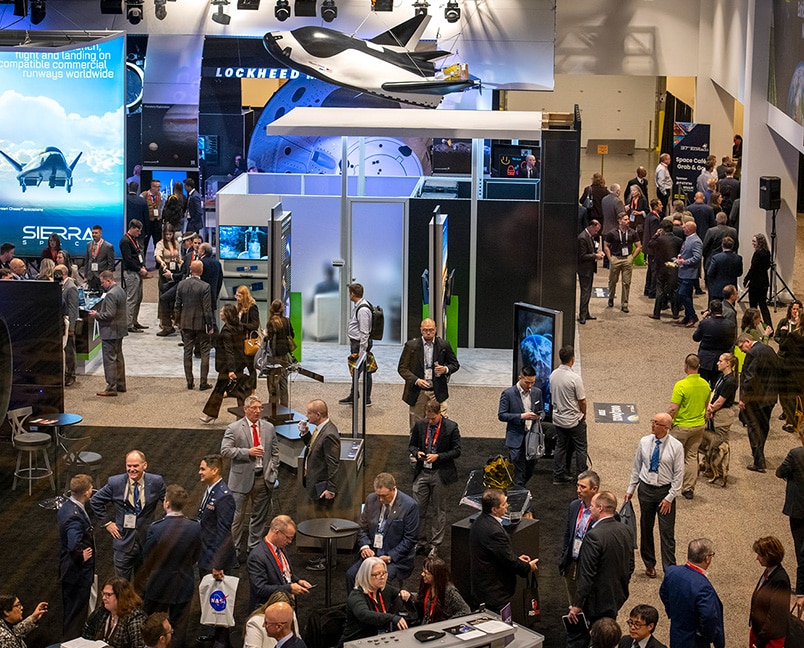
April brings Colorado Springs into sharp focus for the space industry, and Grotnes will be right in the middle of it.
Grotnes, Inc., a Michigan-based leader in metalforming systems and automation, will be exhibiting at the 41st Space Symposium, April 13–16, 2026, hosted at The Broadmoor in Colorado Springs.
You can find us in the Northrop Grumman Exhibit Center – Colorado Hall — 43.
This is the kind of event where conversations move fast, with prime contractors, suppliers, advanced manufacturing teams and program leaders all comparing notes on what’s next.
Where Grotnes Fits in the Space Conversation
Space hardware has a way of exposing weak links. Thin-walled geometries. Critical concentricity. Demanding repeatability across short runs, prototypes and scaled production. Processes that look fine on paper, but get punished by heat, vibration, fatigue and launch loads.
Grotnes technology is built for that reality: forming metal precisely, reliably and intelligently, without treating the part like a compromise.
We engineer and build systems around core processes that matter when performance is non-negotiable:
- Rotary roll forming
- Spinforming
- Shrinking
- Expanding
- Automation integration and cell buildouts
Our team supports customers globally with troubleshooting, spare parts and long-term partnerships, as the machine is only a portion of what makes production work.
Rotary Roll Forming
Rotary roll forming is one of Grotnes’ signature capabilities because it’s a strong answer to a question aerospace teams ask constantly:
How do we form a consistent profile in a cylindrical or conical part without ballooning costs in tooling, scrap or setup?
Grotnes rotary roll forming is a precision cold-rolling process for forming profiled configurations with close tolerances, well suited for cylinders, cones, hoops and rings, especially when you’re making parts of varying diameters with an identical profile.
We’ve highlighted key design elements in past technical coverage of rotary roll forming, including variable infeed for forming (fast approach, slower forming), along with machine features built for control and rigidity.
Spinforming
Grotnes spinforming has been applied heavily to tube forming, helping customers reduce weld-dependent transitions and avoid avoidable assembly complexity. This method can eliminate the need for welded end cone transitions (and related assembly costs) and supports forming both ends and the middle of a tube with options from standalone machines to fully automated cells.
Space and defense manufacturing teams understand the downstream value here:
- Fewer welded transitions to manage
- Fewer inspection choke points
- Cleaner, more controlled geometry transitions
- Better alignment with automation and repeatable setups
Shrinking & Expanding
Two more of our core technologies show up everywhere in serious production environments: shrinking and expanding, often as the enabling step that makes the next operation possible.
Grotnes shrinking is designed to achieve precise outside diameter accuracy by compressing the metal beyond its yield point, using tooling forced inward against the outer diameter.
When you’re dealing with press fits, slip fits, mating components or assemblies where alignment and seal integrity matter, diameter control is foundational.
Automation & Integration
At Space Symposium, you’ll hear a lot of talk about scaling, that is, moving from early production into consistent throughput while keeping quality and traceability intact. The metalforming system has to fit into that reality: upstream handling, downstream inspection, part cooling, coolant management and safe repeatable operation.
Grotnes builds equipment and solutions that support production-ready environments, where the goal is to form metal predictably, again and again, and hand it to the next process cleanly.
Visit Grotnes at Space Symposium

Find Us Here
- Event: 41st Space Symposium
- Dates: April 13–16, 2026
- Location: The Broadmoor, Colorado Springs
- Exhibiting: Northrop Grumman Exhibit Center – Colorado Hall — 43
If you’re attending and want to talk through an application—prototype forming, production concepts, tolerance challenges, difficult geometries or automation considerations—bring it. The best Space Symposium meetings are the ones that get specific.